
KU Leuven researchers have developed a technique for controlled bacterial growth
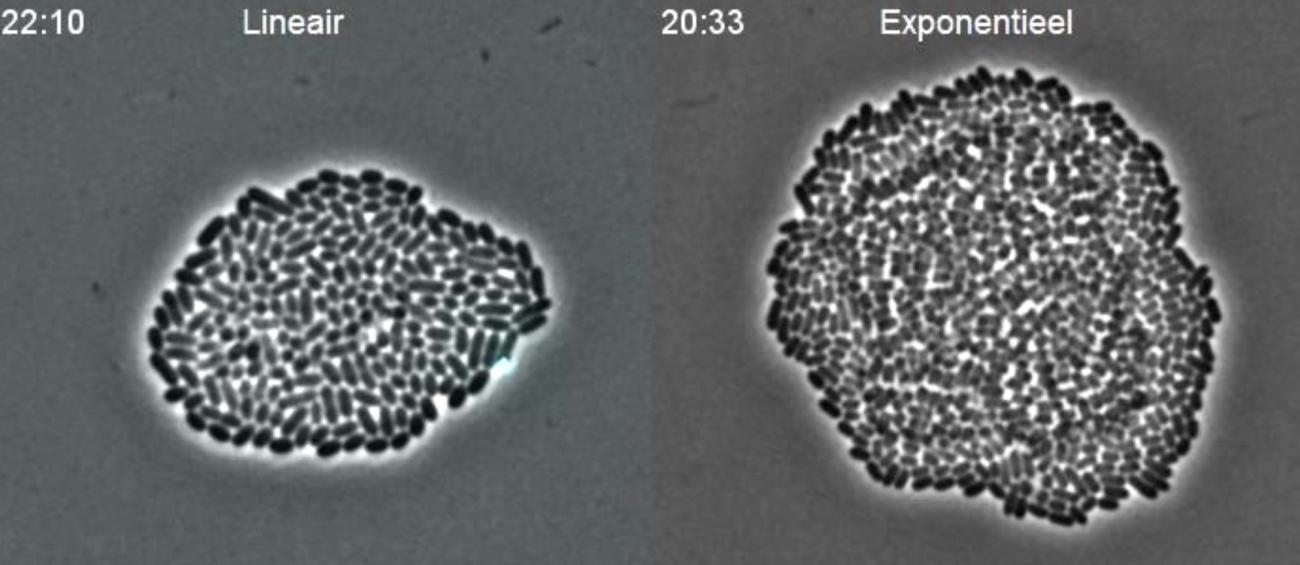
Researchers at KU Leuven have developed a technique that allows genetically modified bacteria to grow in a controlled and temporary way, instead of the traditional pattern of exponential growth. The proof-of-concept study published in Nature Communications puts a limit on bacterial growth, opening up possibilities for the safe use of bacteria in, for example, medicine or agriculture. The technology is currently subject to a patent application.
Bacteria are already widely used in a variety of sectors today. In controlled environments (closed systems), they are used for the production of medication, nutrients, biogas, etc. Bacteria are also used in uncontrolled environments, for example the probiotics you can take to restore your intestinal health. In agriculture, they help protect crops from fungi and insects. They are also used in water treatment and the decontamination of polluted soils.
By nature, bacteria grow exponentially: one cell becomes two, two become four, and so on. This exponential multiplication is efficient from a biological standpoint, but can be challenging in certain situations when applied outside the laboratory. In uncontrolled environments, like medication or probiotics, or the use of bacteria on fields, in stables, water basins, etc – it is important that bacteria do not spread indefinitely.
Reprogramming growth
KU Leuven researchers have developed a technique to reprogramme the growth of E. coli bacteria.
They built a specific genetic system in the bacteria in which a molecule that is needed to process certain nutrients is produced exclusively in a specially designed protein complex in the cell. This protein complex is distributed asymmetrically at each cell division: only one of the two daughter cells inherits it. And so only one cell can continue to grow. The other cell stops growing after a few divisions.
In addition, the protein complex in the cells is gradually broken down. This means that even the one ‘growing’ cell can only undergo division a limited number of times. The result is not exponential, but linear growth: a controlled increase with a built-in expiry date.
‘We do not eliminate bacteria, but change their growth pattern,’ says researcher Ronald van Eyken. ‘Instead of having to intervene afterwards, which usually occurs in the methods used so far, we can determine in advance how many times a bacterium can divide. That makes the system much safer.’
Safety in open applications
This predictability is important for applications in difficult-to-control environments.
Bacteria that you can control open up more possibilities for applications in the human body. For example, bacteria could be programmed to locally produce medication in the gut. Or they could be used to attack specific tumours in the body. The technique opens up opportunities in the livestock industry too. Vaccines could be developed based on bacteria that trigger an immune response and then automatically disappear.
‘When this kind of micro-organisms are used in open fields or in animals, complete control is impossible. Our technique, which limits bacterial growth from the start, provides additional safety,’ says researcher Ronald van Eyken.
‘By reprogramming one of the most fundamental properties of bacterial life, we get a better grip on them,’ says co-author Professor Abram Aertsen from the Department of Microbial and Molecular Systems. ‘Our technique opens doors to new possibilities and safe applications for bacteria.’
The technology is currently subject to a patent application.
More information
Link to the full article: https://www.nature.com/articles/s41467-026-69334-y