KU Leuven-led European consortium secures highly competitive EU funding to advance AI-driven diagnostics for underrepresented breast cancer subtype
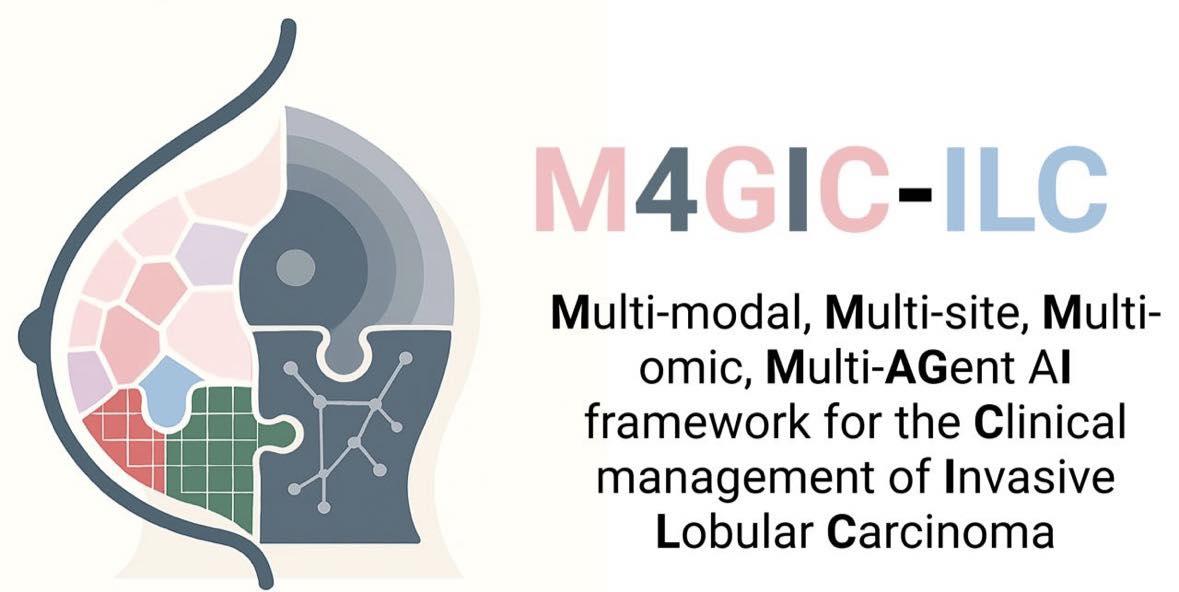
A European consortium led by the KU Leuven Institute for Single Cell Omics (LISCO) and UZ Leuven has secured a prestigious European Innovation Council (EIC) Pathfinder grant to develop an integrated AI-driven approach to improve the diagnosis and treatment of invasive lobular carcinoma (ILC), an underrepresented subtype of breast cancer.
- €4 million EU funding for next-generation AI in breast cancer clinical management
- Multi-modal, Multi-site, Multi-omic, Multi-agent AI framework integrating radiology imaging, pathology and molecular data
- Targeting invasive lobular carcinoma (ILC), difficult-to-detect and underrepresented breast cancer subtype
The project, M4GIC-ILC (Multi-modal, Multi-site, Multi-omic, Multi-agent AI framework for the Clinical management of ILC), brings together a multidisciplinary consortium coordinated by the KU Leuven Institute for Single Cell Omics (LISCO) and UZ Leuven, in collaboration with Institut Curie, UMC Utrecht, the University of Crete, and Collective Minds.
The project was selected under the European Innovation Council (EIC) Pathfinder Challenges program, one of the EU’s most competitive funding instruments for high-risk, high-impact research developing next-generation technologies. Out of 617 submitted proposals, only 30 were funded, corresponding to an estimated success rate of around 5%. The consortium will receive approximately €4 million over three years to develop and validate its approach.
The project targets a critical gap in breast cancer care. Invasive lobular carcinoma accounts for an estimated 10–15% of all breast cancer cases yet remains underrepresented in research and inadequately captured by existing diagnostic tools.
The limitation is structural. Most diagnostic systems and AI models have been developed around more common breast cancer subtypes. ILC’s diffuse growth pattern, low imaging contrast and overlapping pathological features make it inherently more difficult to detect and classify.
At the same time, clinical data remain fragmented. Radiology, pathology and molecular testing generate complementary insights, but AI algorithms typically analyze these in isolation rather than integrating them into a unified view of the patient. This fragmentation limits diagnostic precision and directly affects the performance of existing AI tools.
M4GIC-ILC addresses this challenge by developing a multi-modal, multi-agent AI framework that integrates radiological, pathological, molecular and clinical data into a single, interpretable system to support diagnosis, staging and treatment decision-making.
Building on the clinical and scientific foundations established through the European Lobular Breast Cancer Consortium (ELBCC), the project combines an established European ILC network with next-generation AI technologies capable of integrating radiology, pathology and molecular data within a unified framework.
From fragmented data to clinically relevant AI
The project will leverage retrospective datasets from approximately 10,000 patients across participating institutions, covering multiple modalities and clinical contexts. These data form the foundation for developing robust models tailored specifically to ILC.
The system is designed to support a range of clinically relevant tasks, including diagnosis, tumor staging, relapse risk prediction and treatment benefit estimation, while providing transparent outputs and calibrated uncertainty.
Dr. Asier Antoranz Martinez, leader of computational innovation of the spatial proteomics platform at LISCO: “One of the fundamental challenges in ILC is not only the disease itself, but the way clinical information is currently structured. Radiology, pathology and molecular data each provide valuable insights, but in a research setting, they are often analyzed separately. By integrating these modalities within a single, agentic AI framework, we can move toward a more complete and clinically meaningful understanding of each patient.”
A first step toward clinical implementation
Over the three-year project, the consortium aims to develop a system that can be evaluated alongside clinical workflows in a research or “shadow” setting. This allows comparison between AI-generated insights and clinical decision-making without influencing patient care.
This approach will make it possible to assess concordance, identify where AI adds value, and further refine the models before moving toward clinical validation.
While full implementation will require additional validation, the project is expected to deliver valuable proof-of-concept systems and AI models that can already individually support research and clinical exploration.
A multidisciplinary European consortium
Delivering this approach requires the integration of clinical, computational and research infrastructure across multiple domains.
The M4GIC-ILC consortium builds on prior collaboration within the European Lobular Breast Cancer Consortium (ELBCC), which brought together leading centers working on invasive lobular carcinoma and significantly facilitated the formation of this project. KU Leuven was a co-founder and co-leader of ELBCC, contributing to the scientific and clinical foundations on which M4GIC-ILC is built.
The M4GIC-ILC consortium brings together complementary capabilities spanning the full clinical pathway and the advanced technologies needed to support it.
The KU Leuven Institute for Single Cell Omics (LISCO) and UZ Leuven, as coordinating institutions, lead the integration of clinical insight, digital pathology and AI-driven analysis, ensuring a strong connection between methodological innovation and real-world clinical practice.
The consortium benefits from the involvement of leading clinicians and researchers from KU Leuven and UZ Leuven, including Prof. Christine Desmedt, Prof. Hans Wildiers, Prof. Chantal Van Ongeval, Prof. Francesca Bosisio and Prof. Maarten De Vos, whose expertise spans oncology, radiology, pathology and AI to strengthen the project’s clinical and translational dimension.
The Institute of Women’s Cancer at Institut Curie contributes expertise in invasive lobular carcinoma research, tumor heterogeneity and multimodal data integration across imaging, digital pathology and molecular profiling. The teams involved bring complementary strengths in breast imaging, pathology, genomics and computational oncology, supporting clinically relevant AI development based on real-world patient data.
“This contribution is driven by a multidisciplinary group including Prof. Anne Vincent-Salomon, Dr. Lounes Djerroudi, Dr. Caroline Malhaire and Prof. Thomas Walter, whose expertise spans breast pathology, radiology and AI-driven computational analysis. Their work in imaging–pathology integration and digital biomarker development is central to ensuring clinically interpretable and translatable outputs within the M4GIC-ILC framework,” says the institute.
At UMC Utrecht, the M4GIC project brings together 2 key focus areas within the Department of Pathology: lobular cancer as a rare breast cancer type, and AI.
“The UMC Utrecht is a leading cancer center with a long tradition of breast cancer research and looks forward to participating in the important M4GIC project that will forward diagnosis and treatment of lobular breast cancer,” says Prof. Dr. Paul van Diest.
University of Crete brings specialized expertise in multi-agent AI systems, supporting the development of the project’s integrative modelling architecture.
The Artificial Intelligence and Translational Imaging (ATI) Lab of the University of Crete, with Assist. Prof. Michail Klontzas, Dr. Eleftherios Tzanis and Assist. Prof. Evangelia Vassalou, brings together experts in medical imaging and AI, with extensive experience in agentic AI systems in radiology.
“M4GIC-ILC will revolutionize the management of patients with ILC utilizing state-of-the- art methods. We are excited to support the project by developing the multi-agent AI systems that will bridge the expertise of our partners and enable automation and orchestration of complex pipelines developed within M4GIC-ILC”, says Assist. Prof. Michail Klontzas, head of the ATI Lab.
Collective Minds provides the data infrastructure and platform capabilities required to manage, visualize and integrate large-scale multimodal datasets across institutions.
“We are excited to bring our experience and expertise to M4GIC-ILC. We believe in breaking the silos of healthcare, so data can be safely shared to enable collaboration, in benefit for a very important patient group”, says Anders Nordell, CEO at Collective Minds.
Consortium coordinator Prof. Giuseppe Floris, KU Leuven Department of Imaging and Pathology and UZ Leuven Department of Pathology: “Invasive lobular carcinoma has remained consistently underrepresented, both in research and in the tools used to guide clinical decisions, despite affecting a substantial number of patients. By bringing together all the key disciplines involved in the clinical pathway, from radiology and pathology to AI and clinical research, we can move beyond fragmented assessments and build a more reliable, integrated understanding of the disease. This is essential to improve how ILC patients are diagnosed, characterized and ultimately managed.”
About M4GIC-ILC
M4GIC-ILC (Multi-modal, Multi-site, Multi-omic, Multi-agent AI framework for the Clinical management of ILC) is a European research project funded under the HORIZON-EIC-2025-PATHFINDERCHALLENGES-01 call. The project aims to develop an integrated AI framework to improve the diagnosis, staging and treatment of invasive lobular carcinoma (ILC) by combining radiological, pathological, molecular and clinical data.
The M4GIC-ILC consortium brings together leading European institutions across clinical research, artificial intelligence and data infrastructure: KU Leuven (coordinator, including researchers affiliated with the KU Leuven Institute for Single Cell Omics – LISCO), UZ Leuven, Institut Curie, UMC Utrecht, University of Crete, and Collective Minds.
About the partners
KU Leuven – Institute for Single Cell Omics (LISCO) - Coordinator
The KU Leuven Institute for Single Cell Omics (LISCO) is a multidisciplinary research institute that integrates advanced omics technologies, computational analysis and clinical expertise to better understand human biology and disease. By bridging fundamental research and clinical application, LISCO supports the development of data-driven approaches for improved diagnosis and treatment. https://lisco.kuleuven.be
UZ Leuven
UZ Leuven is a university hospital where patients can count on specialised care and innovative treatments, combined with humane attention and respect for every person. Every day, 10,000 passionate employees provide the best possible custom-made care. Future care providers and employees receive high-quality training in UZ Leuven, with a view lifelong learning and innovation. As a pioneer in clinical research, the hospital also contributes to future patient care. https://www.uzleuven.be/
Institut Curie
The Institut Curie is a foundation recognised as being of public utility, dedicated to research and medical care in oncology, integrating expertise in physics, chemistry, biology, radiobiology and medicine to advance understanding and treatment of cancer. Within this framework, Institut Curie has established the Institut Hospitalo-Universitaire “Institute of Women’s Cancers”, a flagship initiative developed with Université PSL and Inserm. This institute aims to advance a holistic understanding of women’s cancers, particularly breast and gynaecological cancers, by integrating research, clinical care and innovation to improve prevention, treatment, relapse management and quality of life. The Institute of Women’s Cancers is part of the France 2030 strategy and represents a national center of excellence fostering interdisciplinary collaboration between clinicians, researchers and patients to accelerate innovation in women’s cancer care. https://institut-curie.org
UMC Utrecht
The University Medical Center Utrecht is one of the largest academic healthcare institutions in the Netherlands. The Center provides the best healthcare for today’s patients, and we also work towards a healthy society in the future. The organization has three core tasks: care, research and education. https://www.umcutrecht.nl/en
University of Crete
The Artificial Intelligence and Translational Imaging (ATI) Lab is a multi-disciplinary research group based at the Department of Radiology of the School of Medicine at the University of Crete. The lab works at the interface of Radiology and Artificial Intelligence and has extensive expertise in medical image analysis, radiomics, multi-omics integration, deep learning and advanced agentic AI systems. ATI has pioneered multi-agentic systems for radiology and will support the development of agentic systems within M4GIC-ILC. https://www.atilab.net
Collective Minds
Collective Minds is a medical imaging platform that connects hospitals, scientists, and doctors, helping organizations run clinical trials and research to generate high-quality evidence faster and more efficiently. https://www.collectiveminds.health
###
For more information, please contact:
Prof. Giuseppe Floris, Consortium coordinator
KU Leuven Department of Imaging and Pathology and UZ Leuven Department of Pathology
giuseppe.floris@uzleuven.be
Dr. Asier Antoranz Martinez, leader of computational innovation of the spatial proteomics platform
KU Leuven Institute for Single Cell Omics (LISCO)
asier.antoranzmartinez@kuleuven.be